
Ver.iD and PinkRoccade Local Government have announced a strategic partnership to help Dutch municipalities move away from uploading proof documents, toward the direct and reliable verification of digital facts. What makes that shift possible is a wallet on the citizen’s device. Ver.iD provides the certified infrastructure, which works with multiple wallets, and PinkRoccade brings it to the municipal counter. Yivi is one of those wallets, and the one being used in the border municipalities.
Read the announcement at PinkRoccade:

Yivi: one of the wallets, and the one used in the border municipalities
The heart of this partnership is an open trust layer. Ver.iD builds the certified infrastructure to issue, manage, and verify digital declarations securely within the European trust framework. That infrastructure is wallet-agnostic: it works with multiple wallets, so the citizen keeps a choice.
Yivi is one of those wallets, and the one being used in the border municipalities. Yivi lives on the citizen’s device and lets that citizen share verifiable credentials directly from the source. Not a copy of a document, but a cryptographically signed fact that comes straight from the systems of, for example, a bank or a municipality. The receiving party knows for certain that the data is accurate, traceable, and cannot have been tampered with.
Ver.iD is the operator behind Yivi and acts as the multi-wallet intermediary: the layer that connects multiple wallets to the organisations that issue and verify declarations. PinkRoccade Local Government then brings the combination of infrastructure and wallet into municipal practice, embedded in the systems officials use every day.
Robert van Altena (Ver.iD) puts it plainly:
“eIDAS 2.0 makes digital declarations part of the European trust framework. Their value emerges when organisations can be certain that data is reliable, traceable, and directly verifiable. Ver.iD provides the infrastructure to issue, manage, and verify those declarations securely. In collaboration with PinkRoccade, we are bringing this trust layer into municipal practice.”
German citizens served at Dutch municipalities
The most striking use case plays out at the border. Border municipalities face a stubborn problem: a German citizen who wants to arrange something with a Dutch municipality hits a wall at DigiD. DigiD is tied to a BSN (the Dutch citizen service number), and a citizen from Germany usually does not have one. As a result, a whole group of people with legitimate business is structurally locked out of digital services.
With the Yivi wallet, that barrier disappears. A German citizen identifies themselves with their passport or ID card, which is read in Yivi and turned into verifiable credentials, in conformity with eIDAS 2.0, without DigiD and without a BSN. The municipality receives a reliable, directly verifiable proof of identity and can simply help the citizen. This is exactly what European digital identity is meant for: identity that works across the border.
This builds on Yivi’s international digital identity: anyone with a passport can create privacy-friendly credentials in the Yivi app and use them across borders.
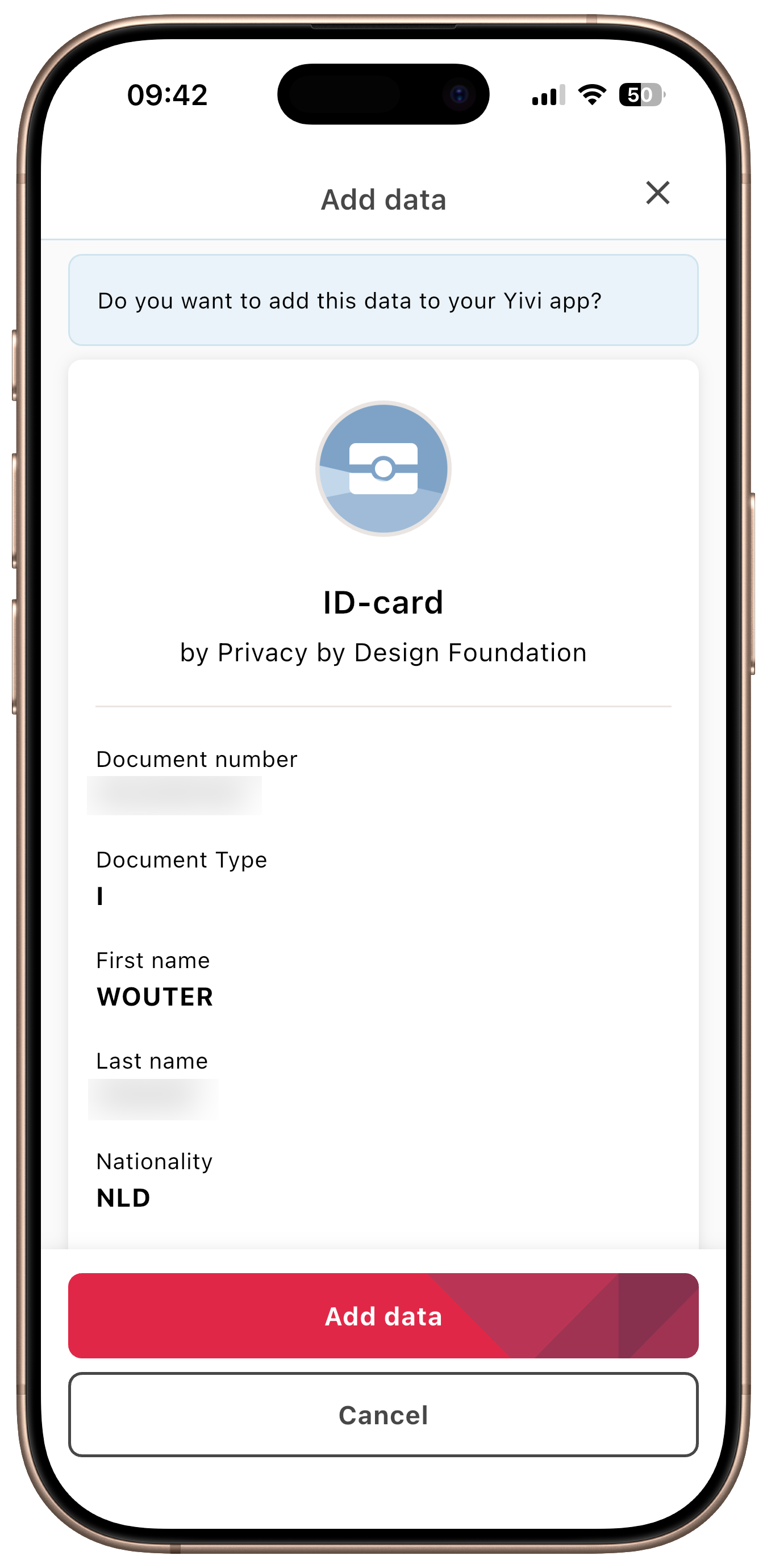
The scale is concrete. It is expected to involve three to seven border municipalities, with an anticipated volume of 20,000 to 50,000 verification requests per year. The planned start date is September 2026. This is not a fringe experiment, but service delivery for tens of thousands of people who currently fall through the cracks.
Do not wait, learn by doing
What we genuinely admire about PinkRoccade’s approach: they are not waiting until everything has been worked out down to the last detail. Around the EU Digital Identity Wallet and eIDAS 2.0, it is tempting to stay on the sidelines until the final specification is set and every question has been answered. That moment never fully arrives.
PinkRoccade chooses to learn by doing. With real municipalities, real citizens, and real use cases. That is exactly the attitude needed to actually move digital government forward. You learn more from one working border municipality than from ten working groups. And because the solution rests on open standards, what you learn today is still useful tomorrow. We believe this is the right way to make the transition to reliable digital facts: start small, learn fast, and scale what works.
More concrete use cases
The border municipalities are not the only thing ready to go. Two more concrete use cases show what the Yivi wallet means in municipal practice.
Digital death certificate
When someone dies, the next of kin face an avalanche of administration. Banks, notaries, and insurers all ask for proof of death. Until now, that has meant repeatedly collecting a paper certificate from the municipality and forwarding it to each party.
In the new approach, the Civil Affairs department (Burgerzaken) issues a digital death certificate directly to the next of kin’s Yivi wallet. That person can then share the certificate themselves, at the moment they choose, with banks, notaries, or other institutions. Directly, reliably, without any intermediary step. This is being tested in the pilot with gemeente Nijmegen, within the Common Ground FieldLab.
Verified financial data for benefit applications
When applying for social benefits or income-based support, citizens must submit bank statements. These are paper or PDF documents that are reviewed manually, with fraud through forged statements as a real risk.
In the new setup, the citizen shares verified financial data directly from the source, through the Yivi wallet, into the municipal application process. The data is cryptographically signed and directly verifiable. Manual checking largely disappears and document fraud becomes structurally harder to carry out.
Citizens retain control
A legitimate concern with any digital innovation is: what does this mean for the citizen? More control or less?
In this model, the answer is clear: the citizen retains control. Data is not forwarded automatically. The citizen decides when to share a declaration, with whom, and for what purpose. The wallet, Yivi, lives on the citizen’s own device. Data exchange, authorisation, logging and auditability are managed by the Ver.iD infrastructure, so it is always demonstrable what was shared, by whom, and when.
Jouke Schrover of PinkRoccade Local Government describes the ambition from the municipality’s perspective:
“Residents expect municipalities to move with what is happening in their lives. With the wallet, we are taking a step toward proactive service delivery. Service delivery where life events are central. Service delivery where residents are supported, without having to find their own way every time.”
That is exactly the principle behind this partnership: not the citizen dragging proof documents to the counter, but a municipality retrieving verified digital facts at the moment they are relevant, with the citizen’s consent.
Built on open standards, ready for Europe
A key advantage of this approach is that it does not rest on vendor-specific technology. Yivi implements open standards such as OpenID4VCI and OpenID4VP, and Ver.iD is certified within the European trust framework of eIDAS 2.0. The direction Europe is taking with the EU Digital Identity Wallet is exactly the direction being put into practice here.
Municipalities that join now are not building on a proprietary system that will need to be replaced later. They are building on the European standard that applies to all member states. That brings durability, interoperability with other countries and wallets, and independence from any single vendor. It also explains why a German citizen will soon be able to use the same wallet at a Dutch municipality: open standards do not stop at the border.
Learn more or get started
- Learn what Yivi is: docs.yivi.app/what-is-yivi
- Common Ground FieldLab: Read our blog about the FieldLab projects
- For developers: yivi.app/for_developers
- Get in touch: questions about implementing Yivi? yivi.app/contact