
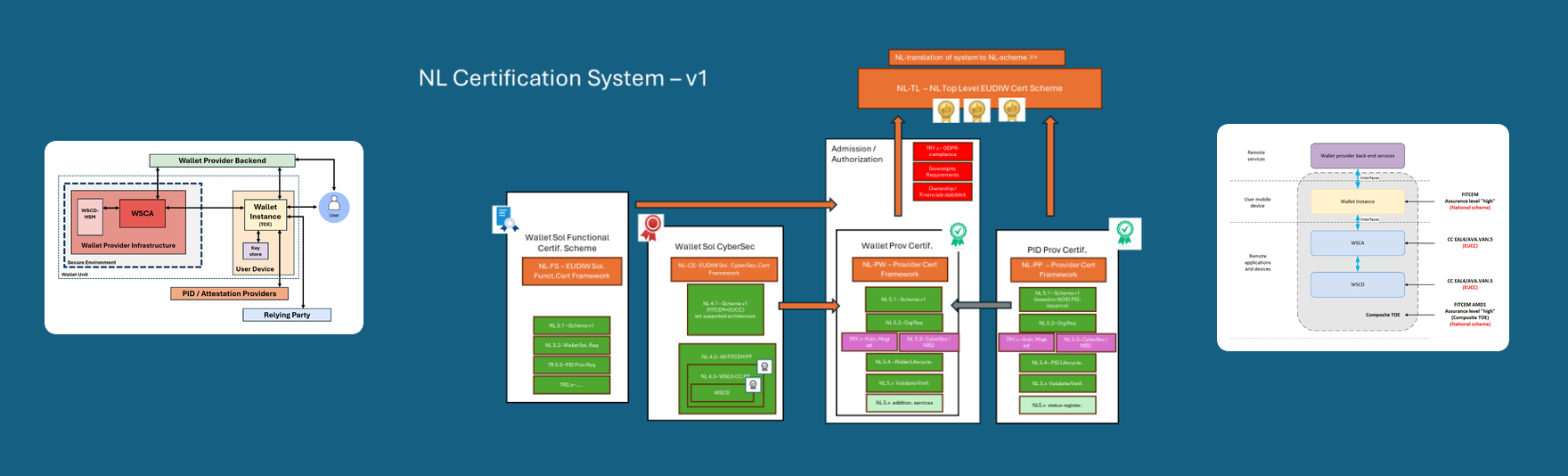
On 5 November 2026 the Netherlands presented the drafts of its certification system for European Digital Identity Wallets. The package is large: 24 published documents, 1,065 pages and 1,123 numbered requirements. Together they describe what a wallet, its provider and the PID provider behind it have to prove before the wallet is admitted to the Dutch electronic identification scheme, the EDI-stelsel.
Yivi wants to be a certified wallet, so we are reading all of it. In this blog we explain how the system works, what exactly is certified, and what it means for an organisation that decides to go for it.
One caveat up front: the documents are release candidates. Feedback can be sent until 31 December 2026, and version 1 is planned for the first quarter of 2027. Details can still change.
Why there is a Dutch certification system at all
The European eIDAS regulation requires every EUDI wallet to be certified before it is offered to citizens. Europe does not yet have one common certification scheme for wallets, so for now each member state sets up its own national system, within rules set in Brussels (Implementing Regulation (EU) 2024/2981).
The Dutch system is owned by the Minister of Economic Affairs, in close concertation with the Minister of the Interior. The actual assessments are not done by the government. They are done by independent conformity assessment bodies (CABs): certification bodies and testing laboratories that are accredited by the national accreditation body. For the top-level certificate a certification body also has to be authorised under Dutch law.
The system aims for assurance level high, both for identity proofing and for the evaluation itself. Self-assessment is not allowed at that level. Everything has to be demonstrated to an independent party.
How it works: three certifications and one certificate on top
The system is built as one top-level scheme that combines the results of three underlying certifications. Each looks at something different, and each uses a different method.
| Certification | What it looks at | Method |
|---|---|---|
| Functional (NL-FS) | Does the wallet correctly implement the protocols, interfaces and data formats that eIDAS and its implementing acts require? | Testing |
| Cybersecurity (NL-CS) | Does the wallet resist attackers with a high attack potential? | Security evaluation |
| Provider (NL-P) | Is the organisation behind the wallet, and the PID provider, in control of its processes, security and lifecycle? | Audit |
| Top-level (NL-TL) | Does the whole set fit together, and are the national admission conditions met? | Review of certificates plus supplementary evaluation |
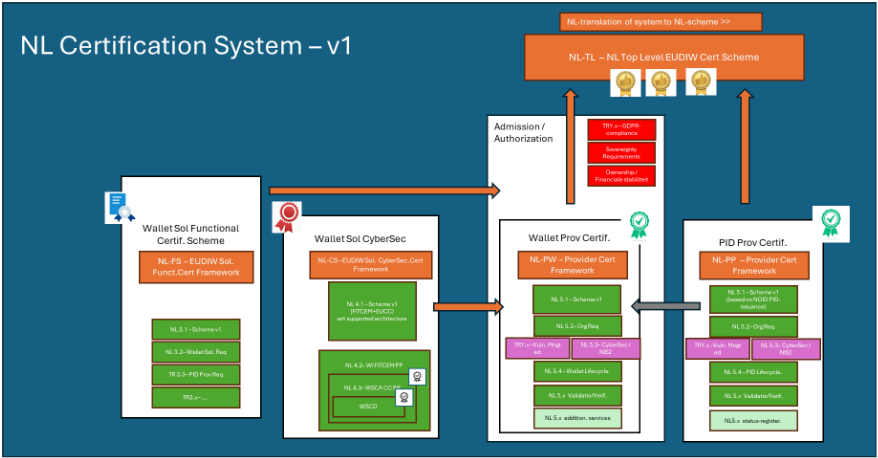
The certificates and declarations of conformity that the system produces. Source: NL-SYS-01, Figure 2.
The top-level certificate is the one that counts in the end. It is issued per wallet provider and it is the certificate the Netherlands reports to Europe for each combination of wallet and PID provider. It can only be issued when:
- the PID provider has an active certificate,
- the wallet provider has an active certificate, and
- the wallet provider shows that it meets the national admission conditions set in Dutch law.
The certification body does not redo work that a valid underlying certificate already covers. It checks that those certificates are authentic, valid and cover the right versions, and it evaluates what falls between them: the dependencies and interfaces, such as the link between the wallet provider and the PID provider.
What is certified
It helps to separate three things: the product, the organisation and the identity data.
The wallet as a product
Version 1 of the system accepts one architecture only: a wallet with a remote HSM. The app on the phone is the Wallet Instance. The security-critical keys do not live on the phone. They live in a hardware security module in the provider’s data centre (the WSCD), which is controlled by a piece of backend software (the WSCA). Wallets that keep their keys in an embedded secure element or an eSIM cannot be certified yet, because the protection profile for those variants does not exist. A wallet without a dedicated secure element is not admitted at assurance level high at all.
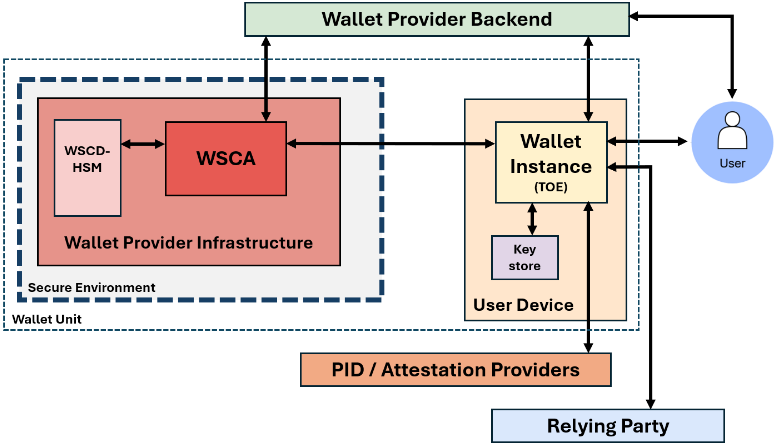
The Wallet Unit in the remote HSM architecture. Source: NL-CS-WI, Figure 1.
That product is then examined in parts:
- Functional behaviour. The developer fills in an Implementation Conformance Statement that declares which features are implemented. That statement determines which test cases apply. The tests are run in a controlled test framework and the outcome is pass or fail. The iOS and the Android version count as separate objects of certification.
- The Wallet Instance. The app is evaluated by a laboratory under FITCEM (EN 17640) at assurance level high. Substantial is explicitly not sufficient. The test set is built on OWASP MAS, with a specific EUDI Wallet profile on top. Alongside the evaluation, the certification body audits the developer’s processes for version control, change management, updates and vulnerability management.
- The WSCA and the WSCD. Both need a Common Criteria certificate under the European EUCC scheme, with resistance against the highest attack potential (AVA_VAN.5).
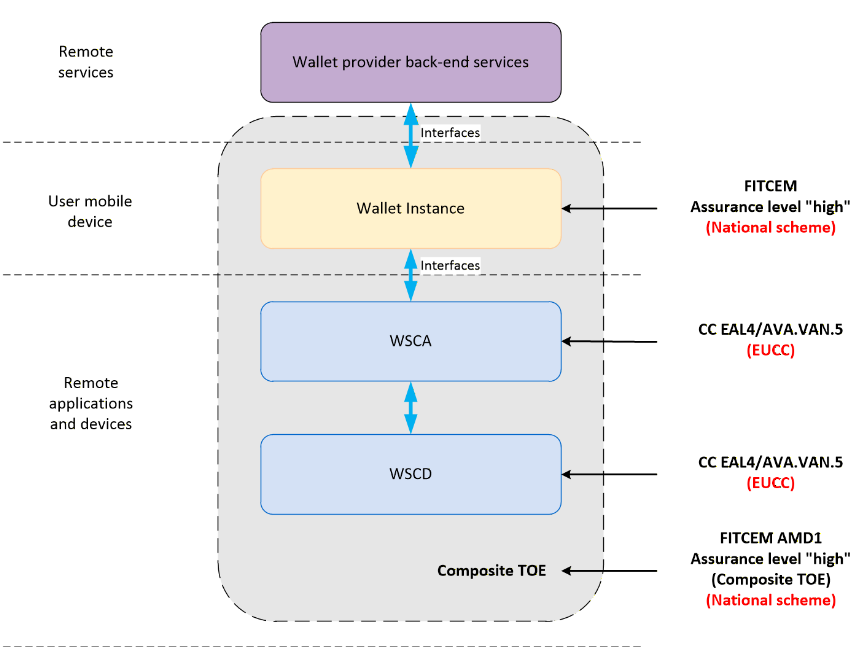
Which part of the wallet is evaluated under which scheme. Source: NL-SYS-01, Figure 5.
The organisation behind the wallet
A secure app is not enough. The wallet provider is audited as an organisation against four sets of requirements:
- general organisational, technical and operational requirements;
- cybersecurity risk management at the level of a NIS2 essential entity;
- secure software development and vulnerability management;
- the full lifecycle of a wallet: onboarding, activation, updates, suspension, revocation and removal.
The PID provider
The person identification data in a Dutch wallet comes from a government-assigned PID provider. That provider is certified under its own scheme, with requirements for issuing, renewing, revoking and deleting PID at assurance level high. A wallet provider does not control this certification, but its own top-level certificate depends on it.
What it means for an organisation that pursues certification
This is where the system gets real. Below are the consequences we see for any organisation that wants to offer a certified wallet in the Netherlands.
1. You need a stack of certificates, in the right order
A wallet provider ends up with a functional certificate, a cybersecurity certificate for the Wallet Instance, EUCC certificates for the WSCA and the WSCD, and a provider certificate. Only then can the top-level certificate follow.
The order matters. A valid functional certificate for the same product and the same version is a precondition for the cybersecurity certificate. The provider certificate is not issued while a functional or cybersecurity certificate is missing, expired or suspended. Planning certification therefore means planning dependencies, with different assessment bodies, each with their own lead time.
2. The architecture is decided for you
Because only the remote HSM architecture is accepted, a wallet provider has to run or buy backend infrastructure with certified hardware security modules. This is a real investment and it shapes the design of the wallet. Organisations that built their wallet around keys in the phone’s secure element will have to rework their architecture or wait for a later version of the system.
You can build the WSCA yourself or buy one that is already certified. Building it yourself adds 169 requirements and a Common Criteria evaluation. Buying one means relying on the supplier’s certificate, and on that supplier keeping it.
3. The requirement count is in the hundreds
For Yivi, as a wallet provider that develops its own WSCA, 936 numbered requirements apply. More than half of them are about the organisation, not the app: 218 for cybersecurity controls, 122 for secure development and 201 for the wallet lifecycle. Not every requirement is a hard “shall”, some are recommended or conditional, but each one needs an answer and evidence.
Existing evidence helps. A certification body may rely on other assurance, such as an ISO/IEC 27001 certificate or audit reports. Per requirement it decides on full reliance, partial reliance or no reliance. An organisation with a mature information security management system starts from a much better position than one without.
4. You pay for it yourself
The system states that each applicant pays the costs of its own certification process and of maintaining its certificate (NL-SYS-01 §3.1.7, p. 11). The documents do not mention amounts in euros, but in two places they do give an indication of the effort.
The evaluation of the Wallet Instance: 156.5 person days. This figure comes from the effort table in NL-CS Part 1, section 5.3 (PDF, p. 15). The table estimates the black-box penetration testing of the app at 1,252 hours for the 35 mandatory requirements: 690 hours for the 22 functional security requirements and 562 hours for the 13 mandatory resilience requirements. Divided by 8 hours per day, that is 156.5 person days. Including the 6 recommended requirements it comes to 1,426 hours, or 178.25 person days. The document itself calls this an estimate to support effort setting, and marks the 8 hours per person day as an assumption that is still to be confirmed. Under FITCEM the effort is fixed: more functionality does not extend the budget.
The provider certification: 30 plus 15 working days. This comes from Table 3 in NL-P-W, section 8.5 (PDF, p. 18). It gives the planned effort of the certification body for an initial certification: 30 working days for the evaluation and 15 for the certification. The scheme calls these maximum and planned values that can change in agreement with the Scheme Owner. Surveillance and recertification are not included.
Those figures cover only two parts, and only the work of the laboratory and the certification body. The functional tests, the Common Criteria evaluations, the top-level certification, the yearly surveillance and all of your own preparation come on top.
5. Certification is a cycle
A certificate is not a finish line. The top-level and provider certificates are valid for four years, the functional and cybersecurity certificates for at most five. In between, the certificate holder is under continuous supervision:
- annual surveillance of the top-level and provider certificates;
- a vulnerability assessment at least every two years;
- critical vulnerabilities and active exploits reported within 24 hours, high-severity vulnerabilities within 72 hours;
- a need for recertification reported at least six months before a certificate expires.
If a nonconformity is found and the holder’s explanation is not sufficient, there are at most 30 calendar days to propose corrective measures. After that the suspension procedure starts. And because the top-level certificate depends on all the others, a suspended underlying certificate can suspend the whole.
6. Releasing software becomes a regulated activity
This may be the biggest change for a development team. In the cybersecurity scheme the developer notifies the certification body of planned changes before they are implemented. The certification body then decides per change whether it is covered by the existing certificate, needs a special evaluation of the affected requirements, or needs a full evaluation. A new wallet version that the existing certificate does not cover can even trigger recertification of the provider.
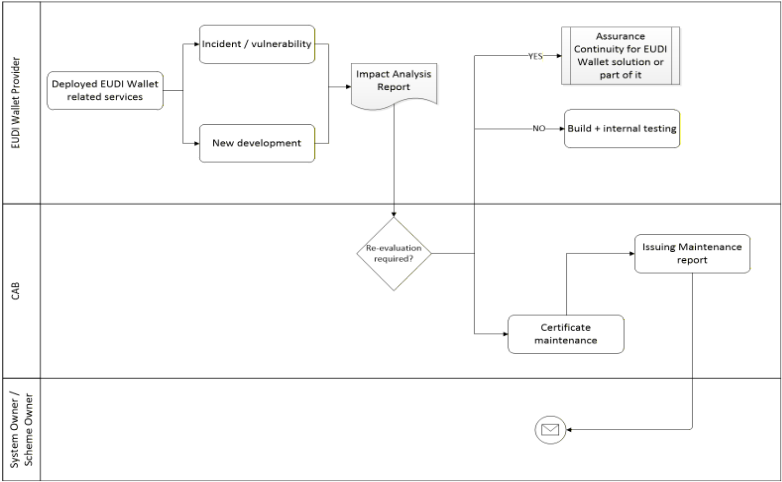
The change management process of the certification system. Source: NL-SYS-01, Figure 4.
A team that ships every two weeks needs to think about how its release process, its impact analyses and its evidence fit into that rhythm.
7. Some pieces are still missing
The national admission conditions, which every wallet provider has to meet, are not published yet. The documents contain a placeholder for Dutch national law. The risk register document is also still under construction. An organisation can start preparing now, but cannot yet draw up a complete plan.
What Yivi is doing
Yivi is building all the software components a certified wallet needs, and is preparing for certification. That covers the wallet app itself and the wallet provider backend, including our own WSCA on top of a certified HSM as WSCD.
Alongside the building we are going through the schemes requirement by requirement. To make that easier for ourselves and for others, we published the whole system in a searchable form: an explanation of how it works, a page per document, every requirement with a link to the page of the original PDF, and the full text. You can find it at docs.yivi.app/edi-stelsel-certification. We will also send our feedback to the EDI-stelsel before the deadline of 31 December 2026.
Let’s work together
Nobody has to do this alone. Every organisation that goes for certification faces the same requirements, the same architecture and the same open questions, and Yivi is open source. If your organisation wants to cooperate, for instance by sharing wallet provider knowledge or software such as the WSCA and WSCD components, feel free to reach out. We are happy to compare notes.
Learn more
- Explore the certification system: Dutch EUDI Wallet certification on docs.yivi.app
- Search every requirement: Requirement search
- The numbers for a wallet provider: What the schemes mean for a wallet provider
- Yivi and the EUDI Wallet: Yivi takes a major step toward EUDI Wallet compatibility
- Get in touch: yivi.app/contact