

For twenty years a bank that approved a payment did so with a tool it had chosen, built and monitored itself: first a card reader or token, now its own app. From the end of 2027 a customer can ask to approve that same payment with an app the bank did not build, cannot inspect and does not operate: an EUDI wallet. The bank’s liability towards that customer does not change.
That is the gap the European Payments Council (EPC) wants to close with SCARLET. In this blog we explain what strong customer authentication looks like as a credential in a wallet, what SCARLET is, why banks need it, what a bank actually gives up when authentication moves to a wallet, and why liability is the part everything else depends on. We write this as a private wallet provider, so we sit on the other side of the table. We think the banks’ concern is legitimate, and we also think the answer cannot be to move all the risk to the wallet.
Strong Customer Authentication in short
Strong Customer Authentication (SCA) is the PSD2 requirement that a payment service provider is sure it is dealing with its own customer before something risky happens. It applies when a customer opens their account online, initiates an electronic payment, or does anything else remotely that carries a risk of fraud.
SCA has three ingredients, worked out in the EBA technical standards:
- Two independent factors out of three categories: something only the customer knows (a PIN), something only the customer has (a registered phone, a card), and something the customer is (a fingerprint, a face). Breaking one factor must not break the other.
- An authentication code that results from those factors, can be used once, and cannot be forged or replayed.
- Dynamic linking for remote payments: the customer sees the amount and the payee, and the authentication code is tied to exactly that amount and that payee. Change either one and the code is worthless.
In today’s banking app this looks simple. The app is registered on your phone (possession), you enter your PIN or use your fingerprint (knowledge or inherence), you see “€ 250 to Bol.com”, and you approve. Behind the screen the app signs that transaction with a key that only exists on your phone.
SCA as a credential in a wallet
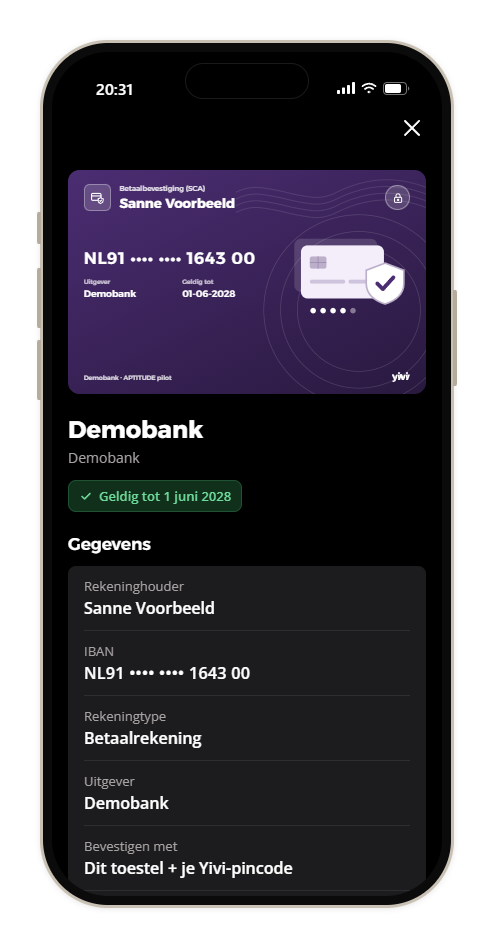
An EUDI wallet holds credentials: digitally signed statements from an issuer about the holder. A passport, a diploma, a home address. SCA can be expressed in the same form. The bank issues a credential that says, in effect: the holder of this credential is our customer, for this account. In the payments specification for the EUDI wallet (TS12) this is called an SCA attestation.
A payment then goes like this. The customer pays at a web shop. The bank sends a request to the wallet: present your SCA attestation for € 250 to this payee. The wallet shows the amount and the payee, the customer confirms with their PIN, and the wallet returns a presentation signed with the key that belongs to the attestation. The bank checks that the signature fits the attestation it issued and that it covers this amount and this payee. If so, the payment is authenticated.
The elements of SCA map onto the credential as follows:
| SCA element | In the bank’s own app | As a credential in a wallet |
|---|---|---|
| Enrolment | The bank activates its app on the customer’s phone | The bank issues the SCA attestation into the wallet, after identifying the customer with its existing means |
| Possession | A key in the banking app, bound to the phone | The attestation is bound to a key protected by the wallet’s secure hardware and cannot be copied to another wallet |
| Knowledge or inherence | The banking app’s PIN or biometric | The wallet’s PIN or biometric, which unlocks that key |
| Dynamic linking | The app shows amount and payee and signs them | The bank’s request contains amount and payee, the wallet shows them, and the signed presentation includes them |
| Authentication code | A signature from the banking app | The signed presentation of the attestation, which the bank verifies |
| Revocation | The bank blocks the app | The bank revokes the attestation |
Note what has happened. The credential comes from the bank, and the decision to execute the payment stays with the bank. But both factors, the screen on which the customer sees the amount, and the key that produces the authentication code now belong to the wallet. That is where the liability question starts.
What SCARLET is
SCARLET stands for SCA acceptance Rulebook and Liability framework for EUDIW Transactions. It is a scheme of the EPC, the body behind the SEPA payment schemes, developed on invitation of the European Commission and with the Commission and the EBA closely involved. The EPC Board approved it on 24 September 2026 and announced it on 19 October 2026 (press release, PDF). It is the first time the EPC moves beyond payment schemes into digital identity infrastructure.
The scheme will have four parts:
- a business and contractual framework: who the scheme actors are, who is eligible, and what their rights and obligations are;
- common functional and operational rules;
- technical specifications that reuse the Architecture and Reference Framework (ARF 3.0.0), the payments specification TS12 and the findings of the Large Scale Pilots;
- a liability framework between payment service providers (PSPs) and wallet providers.
Version 1.0 is written under PSD2 and the EBA technical standards on SCA. Version 1.1 extends it to the Payment Services Regulation (PSR). What that means is covered further down.
Why now
The driver is eIDAS 2. Article 5f(2) says that private relying parties that are required to use strong user authentication, banking and financial services among them, must accept the EUDI wallet when the user voluntarily asks for it. The deadline is 24 December 2027. Member states must offer at least one wallet by 24 December 2026.
The EPC expects more than 3,000 PSPs and more than 27 wallet providers in the EU and EEA. Without common rules that is 3,000 times 27 bilateral questions about technology, contracts and liability. A scheme turns that into one rulebook that each party signs up to once.
The paradigm shift: liable for a tool you did not choose
Under PSD2 the allocation is simple and strict. If a payment was not authorised, the bank refunds the customer. If the bank did not apply SCA, the customer bears no loss at all unless they acted fraudulently. And the burden of proof lies with the bank: it has to show that the payment was authenticated, and the mere fact that the credentials were used is not enough to prove the customer authorised it.
Banks could accept this because they chose and controlled the SCA tool, a point The Quantum Space describes as a paradigm shift. They decided how it was built, how customers enrolled and what it logged. With an EUDI wallet that link is cut. The citizen picks the wallet. The bank must accept it. The bank stays liable to the customer.
SCA in a banking app is much more than two factors
It is tempting to see SCA as a PIN plus a device, and to conclude that any certified wallet can do that just as well. On the cryptography that is true. But a modern banking app does far more at the moment a customer approves a payment, and most of it has nothing to do with the two factors. A banking app is as much a fraud sensor as it is an authenticator. The Dutch Payments Association makes the same point: SCA under PSD2 covers more than two-factor authentication.
What banks have built into their own apps over the years:
- Device binding and controlled enrolment. The bank decides how an app is activated on a new phone: with an ID scan, a card reader, a letter or a visit to a branch. It also decides what a freshly enrolled device may do.
- Device integrity. Detection of rooted or jailbroken phones, emulators, hooking frameworks, repackaged apps and known malware, with app shielding to resist tampering.
- Overlay, screen sharing and remote access detection. The app notices when another app draws over it or when the screen is being shared through a remote support tool, which is the standard helpdesk fraud scenario.
- Call detection. Several banks show a warning, or block the approval, when the customer is on a phone call while approving a payment. This targets bank impersonation directly.
- Behavioural signals. How the customer types, swipes and navigates, and whether this session looks like that customer or like someone being coached through the screens.
- Context for risk scoring. Device fingerprint, location, network and session history feed the bank’s transaction monitoring in real time.
- Dynamic linking on a screen the bank designs. The customer sees amount and payee in an interface the bank controls, with its own wording and its own position for warnings.
- Targeted friction. Contextual warnings (“are you being asked to move money to a safe account?”), cooling-off periods after a limit increase or a new device, delayed execution for unusual payments.
- Recovery and kill switch. The bank decides how a customer gets access back after losing a phone, which is a classic takeover route, and can block an app instance instantly.
- Evidence. The bank holds the logs of every step, in the form it needs for a dispute or a regulator.
Most fraud losses today are not broken cryptography. They are customers who are manipulated into approving a payment themselves. The controls above exist for precisely that case, and they live in the app.
What changes when the wallet does the authentication
As described above, in the TS12 model the account servicing PSP issues the SCA attestation, the wallet presents it bound to the transaction, and the bank verifies it. The wallet is the carrier and the authenticator. It is not the party that authorises the payment.
That leaves the bank with important levers, and takes others away.
| Control | Bank’s own app | EUDI wallet |
|---|---|---|
| Decision to issue and revoke the SCA attestation | Bank | Bank |
| Server-side transaction monitoring, limits, payee checks | Bank | Bank |
| Final decision to execute or decline | Bank | Bank |
| Enrolment and recovery of the app on a device | Bank | Wallet provider |
| PIN and biometric policy, retry limits | Bank | Wallet provider |
| Device integrity and malware checks | Bank, tuned to its own fraud patterns | Wallet provider, to certification requirements |
| Screen sharing, overlay and call detection | Bank | Not under the bank’s control, and not a standard wallet requirement |
| Behavioural and device signals for risk scoring | Bank | Not shared with the bank |
| Approval screen, warnings and friction | Bank | Wallet provider, within what the specifications allow |
| Speed of reaction to a new attack pattern | Bank’s own release cycle | Wallet provider’s release cycle, with certification change management |
| Logs and evidence of the approval | Bank | Split between bank and wallet provider |
Three points stand out.
The signals stop. An EUDI wallet is built for data minimisation. It is not supposed to tell a relying party what else is happening on the phone, and a wallet provider is not supposed to see what its users do. From a privacy perspective this is the point of the design. From a fraud perspective it means the bank’s risk engine loses its richest source of input at exactly the moment of approval.
The moment of approval moves. The warning that a customer is on the phone, the extra question for an unusual payee, the cooling-off timer: these work because the bank owns the screen on which the customer says yes. With a wallet the customer says yes somewhere else. The bank can still add friction before and after, in its own channel, but not in the approval itself.
Certification is not fraud prevention. EUDI wallets are certified at assurance level high, and as we described last week that is a heavy regime. But it certifies that the wallet resists attackers and that the provider controls its processes. It says little about a customer who is talked into approving a payment by a fake bank employee. That was never the wallet’s job. It has been the bank’s job, and the bank did it in its app.
So the bank’s position is this: it must accept an authentication tool it cannot see into, it loses part of its fraud controls, and under PSD2 it refunds the customer first. Under the PSR this gets heavier. That is why a common rulebook is needed, and why liability is not a chapter of SCARLET but the heart of it.
What the PSR changes
SCARLET 1.0 is written for the law as it stands: PSD2 and the EBA technical standards. Version 1.1 follows the Payment Services Regulation, which replaces the conduct rules of PSD2 with a regulation that applies directly in every member state. The PSR is agreed but not yet in force. The final compromise text was published in 2026, formal adoption is expected in December 2026, and most of it will apply 21 months after entry into force, so in the course of 2028.
The PSR does not solve the liability question between banks and wallet providers. It makes that question more expensive to leave open. Four changes matter here, based on the agreed text and the summaries published so far:
- A refund right for impersonation fraud. Under PSD2 a customer who is talked into approving a payment by a fake bank employee has formally authorised it, and a refund depends on national practice or goodwill. The PSR gives the customer a right to a refund when a fraudster impersonates the bank, unless the customer was grossly negligent or took part in the fraud. This is the same category of fraud for which banks built call detection, screen sharing detection and in-app warnings. With a wallet those controls are out of the bank’s hands at the moment its liability for that fraud becomes law.
- Heavier duties on monitoring and data sharing. PSPs must run transaction monitoring that supports SCA and detects fraud, and they may share fraud data with each other. A bank that receives fewer signals from the approval step has to compensate for that server-side, and will want to know what a wallet can tell it.
- Outsourcing of SCA becomes a formal category. As RegReporting Desk describes, the PSR requires an outsourcing agreement when a technical service provider provides and verifies the elements of SCA for the payer’s PSP, and a recital says that the PSP keeps full liability when the operator of a pass-through wallet fails to apply SCA. Whether an EUDI wallet provider falls under this depends on the final wording and on what the wallet actually does. If it does, the bank needs a contract with every wallet it accepts, which is not something 3,000 PSPs and 27 or more wallet providers can do bilaterally.
- No statutory liability for technical service providers. The Commission’s 2023 proposal made technical service providers directly liable for damage when they fail to support SCA. According to Freshfields that rule did not survive the negotiations. The law therefore says who pays the customer, which is the bank, and leaves recourse against the wallet provider to contract. That contract is SCARLET.
So the PSR raises the stakes on both sides. For banks, more fraud falls under mandatory refund while part of the prevention moves out of their app. For wallet providers, the outsourcing frame brings contracts, audit rights and supervision closer. This is also why the split in two versions deserves attention: version 1.0 sets the structure under PSD2 rules, and version 1.1 has to fit a considerably heavier liability regime into that structure roughly a year later. Banks and wallet providers should read the first rulebook with the PSR already in mind.
Why liability decides everything else
Every other part of the scheme follows from the answer to one question: when a wallet-authenticated payment turns out to be fraudulent, who bears which part of the loss, and under what conditions?
- If the bank bears everything, banks will want strict eligibility rules for wallets, extra technical requirements and audit rights on top of eIDAS certification.
- If the wallet provider bears part of it, the provider needs revenue or insurance to cover that, and the scheme has to say something about remuneration.
- If nobody knows, every dispute becomes a bilateral legal argument, which is the situation the scheme is meant to prevent.
One analysis summarised it well: the liability allocation will shape the economics of every wallet-authenticated transaction.
At this moment none of this is decided. There is no rulebook text yet. Nothing has been published about fees or remuneration. It is not clear what eligibility for wallet providers will look like, whether it goes beyond eIDAS certification, or whether wallet providers will have to formally adhere to the scheme the way PSPs adhere to SEPA schemes. The first real text is expected with the public consultation in the summer of 2027.
Some directions are visible:
- The outsourcing frame. The draft terms of reference for the multi-stakeholder group put the design of outsourcing requirements between PSPs and wallet providers in scope, and the PSR envisages an outsourcing agreement where a technical service provider provides and verifies the elements of SCA for a PSP. This cuts both ways. In an outsourcing relation the PSP stays responsible and normally pays for the service. The provider in turn accepts SLAs, audit rights and supervisory requirements.
- Fault-based liability tied to certification. A wallet provider is liable when the loss follows from a failure of the wallet or a breach of its certified obligations, and not otherwise.
- Caps and insurance. Liability per incident or per year is bounded, and insurable.
- State backing for public wallets. A member state stands behind its own wallet. This solves the problem for public wallets and creates one for private providers.
- A default fee model. The EPC has done this before. In the SPAA scheme default fees between participants were calculated by an independent economic consultant.
The view from a wallet provider
eIDAS 2 (Article 5a(13)) makes issuance, use and revocation of a wallet free of charge for natural persons. That is right. But it means a wallet provider has no revenue from the user. If SCARLET gives banks recourse against wallet providers and stays silent on remuneration, a private wallet provider carries payment risk for 3,000 PSPs with no income to set against it. No serious organisation can sign that.
Our position, as input for the discussion:
- Liability must be fault-based and bounded. A wallet provider should answer for what it controls: the wallet, its keys, its processes. It cannot answer for the bank’s risk decisions, or for social engineering that no authenticator can prevent.
- A scheme that assigns risk must also address remuneration. Risk without revenue is not a business model. If the outsourcing frame is used, it should be used completely, including the part where the outsourcing party pays for the service.
- Public and private wallets need a level playing field. If state-backed liability becomes the entry ticket, only member state wallets will be accepted for payments, and the choice eIDAS 2 gives citizens becomes theoretical.
- Solve the fraud signal problem with design, not with surveillance. Banks need assurance at the moment of approval. Wallets must not become telemetry channels. There is room in between: clear requirements for what the wallet checks itself, and standardised, minimal signals that a user can understand.
Evidence reduces the liability question
A large part of any liability discussion is in fact an evidence discussion. Who can prove what happened? Under PSD2 the bank has to prove that the customer authenticated the payment. With a wallet, part of that proof sits with the wallet provider.
This is an area where wallet design matters. Yivi is building its own WSCA on SECDSA, a split-key scheme in which a signature can only be produced by the user’s device and the user’s PIN together with the provider’s hardware security module. A property of that design is that the approval of a specific transaction leaves cryptographic evidence that the provider cannot produce on its own. In a dispute, that helps to separate three cases that otherwise blur: the wallet failed, the customer’s device and PIN were used, or the transaction data were changed along the way.
Better evidence does not answer who pays for social engineering. It does make the fault-based model workable, because fault can be established.
Who is at the table
The governance matters as much as the content. The SCARLET Task Force, made up of PSP-side EPC members, writes the rulebook and the technical specifications. The EPC Board approves them. A Multi-Stakeholder Group (MSG) advises both.
According to the draft terms of reference the MSG has at most 30 members: the Task Force chair, up to four further PSP-side members, up to 11 EUDI wallet providers, up to two Large Scale Pilots, and up to 12 members from consumer, merchant and corporate associations, commercial wallet providers, technology vendors and standardisation bodies. DG CNECT, DG FISMA, ENISA, FIDO, ETSI and the OpenID Foundation are observers. It has two co-chairs, one PSP and one wallet provider. It decides by consensus, or else by a two-thirds majority, and minority positions are reported to the Board.
Two things are worth noting. The MSG is advisory only, which is a weaker position than the MSG had in the SPAA scheme, where it maintained the rulebook and the default fees. And with more than 27 wallet providers and 11 seats, most seats are likely to go to member state wallets. The parties whose liability is being arranged do not hold the pen.
Timeline
| Date | Milestone |
|---|---|
| 24 September 2026 | EPC Board approves SCARLET |
| 19 October 2026 | Public announcement |
| 20 November 2026 | Draft terms of reference for the MSG published with the call for candidates |
| 11 December 2026, 18:00 CET | Deadline for MSG applications |
| 24 December 2026 | Member states must offer at least one wallet. This deadline will not be met everywhere: the Netherlands, for one, does not expect the NL Wallet before 2028 |
| Summer 2027 | Public consultation on version 1.0 |
| December 2027 | Publication of version 1.0, followed by an implementation period |
| 24 December 2027 | eIDAS 2 acceptance deadline for banks. May slip as well if the wallets it depends on are late |
| 2028/2029 | PSR expected to apply, version 1.1 |
Two things in this timeline do not fit.
First, the wallet deadline of December 2026 is not being met. Member states are behind, and the Netherlands does not expect its own wallet until 2028. The acceptance obligation for banks was set one year after the wallets were supposed to exist. If the wallets are late, there is little for a bank to accept on 24 December 2027, and it becomes hard to defend holding banks to a date that member states themselves missed. We therefore expect that the acceptance deadline may be postponed as well, formally or in the way supervisors enforce it. To be clear: that is our expectation. Today the date is in the regulation and nothing has been decided.
Second, the rulebook is published in the same month the acceptance obligation starts. The implementation period for building, testing, onboarding and certification comes after that.
Neither point is a reason to wait. A possible delay is not a plan, wallets from other member states and from private providers can arrive earlier than the national one, and the liability rules are being written now. Banks will have to prepare their wallet acceptance before the rules are final.
What to do now
If you work at a bank or PSP:
- Map which of your fraud controls live in your app and which live server-side. The first group is what you lose sight of with a wallet. The second group is what you can strengthen.
- Decide what your SCA attestation policy will be: who gets one, for which wallets, with which limits, and when you revoke it.
- Follow SCARLET through your EPC representation and respond to the consultation in the summer of 2027.
- Talk to wallet providers now. The questions on both sides are concrete and neither side can answer them alone.
If you are a wallet provider: apply for the MSG before 11 December 2026, and respond to the consultation. The call for candidates is on the EPC website.
If you work on payments or fraud at a bank and want to compare notes on what a wallet can and cannot give you, get in touch. We would rather find out together now than in a dispute in 2028.
Learn more
- The EPC call for the SCARLET MSG: europeanpaymentscouncil.eu
- The EPC announcement: press release and news item
- The MSG terms of reference: EPC281-26, draft (PDF)
- SCA with the wallet, technically: TS12 on GitHub and the APTITUDE pilot on payments with SCA
- The banks’ reading: Dutch Payments Association on eIDAS 2 and payments
- The PSR: final compromise texts (A&L Goodbody) and what the new rules mean (Freshfields)
- Coverage and analysis: The Paypers, Biometric Update, The Quantum Space, RegReporting Desk, FinanceX Magazine
- The acceptance obligation: Regulation (EU) 2024/1183, Articles 5a and 5f
- What certification of a wallet covers: The Dutch certification system for EUDI wallets
- Yivi and the EUDI Wallet: Yivi takes a major step toward EUDI Wallet compatibility
- Get in touch: yivi.app/contact